Clarity Takes Time
Time is often treated like something to spend. And managers often say things like - don't waste your time on... - focus on... - why did you spend time on...
The use of time is important but I'd argue that using time for clarity is an incredible use of it. The best leaders use time for clarity. They don’t rush decisions just to feel productive. They invest time upfront to align on intent, ownership, and outcomes - so execution doesn’t unravel later.
Clarity takes time - time to ask the right questions - time to remove ambiguity - time to make sure everyone hears the same message. Skipping that step doesn’t save time. It just pushes the cost downstream into rework, meetings, more meetings, frustration, and meetings about being frustrated.
When time is used well, teams move faster after the decision. When it isn’t, everyone stays busy without moving forward. Time spent creating clarity isn’t overhead. It’s one of the highest-return investments a leader can make.
Today is the Day!
I've had the honor of speaking at numerous universities and colleges about a range of topics including entrepreneurship, business management, supply chain, marketing, and the impact of big box on small town Main Streets. I have always tried to recycle the following into each of those presentations:
Today is the day. Not tomorrow. Not next quarter. Not after one more meeting, one more slide, one more “alignment” conversation. Today.
The strategy doesn’t get clearer by waiting. The risk doesn’t get smaller by delaying. The gap doesn’t close itself.
Most breakthroughs don’t come from perfect plans - they come from a decision to move, learn, and adjust in real time. Send the email. Make the call. Have the hard conversation. Start the thing you’ve been talking about for months. Momentum is created, not scheduled.
Removing Emotion
One of the hardest leadership skills to learn is making decisions without emotion. Not ignoring emotion - but not letting it drive the result.
When decisions are emotional, the loudest voice wins. Short-term relief overrides long-term impact. Data is secondary.
Unemotional decisions are grounded in facts, trade-offs, and consequences. I'm not advocating for being cold or detached. I'm suggesting that removing emotion creates enough distance to ask better questions. What problem are we actually solving? What happens if we do nothing? What can be undone and what cannot?
The best leaders feel deeply. The can be emotional. They just don’t make decisions impulsively because calm decisions build trust. Consistent decisions build credibility. And in moments of pressure, clarity - not emotion - is what moves organizations forward.
Sunday Mornings
Sunday morning ritual.
Same Starbucks. Same order. Same quiet moment before the week starts asking questions.
It’s one of the few times the world slows down just enough to think clearly. No meetings. No spreadsheets. No urgency disguised as importance. Just a cup of coffee and a little perspective.
These small routines matter more than we admit. They create space to reflect, reset, and remember that leadership isn’t only built in boardrooms or warehouses - it’s built in the pauses between them.
By Monday morning, the pace will pick up again - it always does. But for a few minutes on Sunday, coffee in hand, it’s enough to simply be still and get ready for what’s next.
Character Building
Nothing builds character like explaining an Out of Stock when the inventory report says you’re overstocked.
Girl Scout Cookies
Unless you are selling Girl Scout Cookies - No Soliciting.
If you’ve messaged me in the last 30 days, there’s a strong chance you’ve offered me one of the following:
• Franchise ownership opportunities
• Resume writing services
• “Guaranteed” lead generation
• A revolutionary AI tool that will “change everything”
• Something you promise is definitely not spam
It feels like my inbox has been reclassified as a digital flea market. At this point, the volume is approaching early-2000s Nigerian prince levels. The only difference is he wanted to give me money, and you want me to send you some.
To be clear - I’m not looking to buy a franchise - I’m not outsourcing my résumé - And if I was ready to change my life, it probably wouldn’t start with a cold email that begins with “Hope this finds you well.”
I do admire the hustle. Sales is hard. Rejection is real. And someone, somewhere, absolutely needs what you’re selling. Just…maybe not everyone. Especially not before coffee.
If nothing else, thank you for reinforcing the value of a strong spam filter and reminding me that some traditions never die.
Happy selling. Happy scrolling. And please…stop “circling back.”
From Worn Out to New Life
Throwback Thursday: Taking a former meat packing plant and turning it into a modern ecommerce fulfillment center built for the cold chain.
When the mandate was to find a facility to support 5x growth but keep the cost below market - you tend to get creative. When you can tie that creativity and mandate into revitalization - it's a big win.
It was a full gut and rebuild - freezer, cooler, packing areas, dry storage, offices, training space, redesigned docks, and a custom CO₂ removal system to safely support dry ice at scale.
But beyond the construction, there was something more meaningful happening - I was giving new life to something worn out. If you know me - you know that I see what others cannot. I see the value in what is deemed unworthy - buildings, systems, people.
Some lessons from this project:
- Buildings dictate behavior. If a space is tired, inefficient, or unsafe, it quietly teaches bad habits. Thoughtful design restores discipline by default.
- Design for reality, not nostalgia. Old facilities weren’t built for ecommerce, cold chain, or scale. Honoring the past doesn’t mean being constrained by it.
- Safety and efficiency grow together. Modern ventilation, dock flow, and temperature control didn’t slow the operation down - they made it safer, faster, and more humane.
- Renewal is a leadership choice. Revitalizing a worn-out building mirrors what good leaders do with teams and systems: remove friction, invest intentionally, and create conditions where performance can return.
This didn’t just repurpose a facility. It restored purpose, reduced risk, and built future capability into old walls.
Second chances!
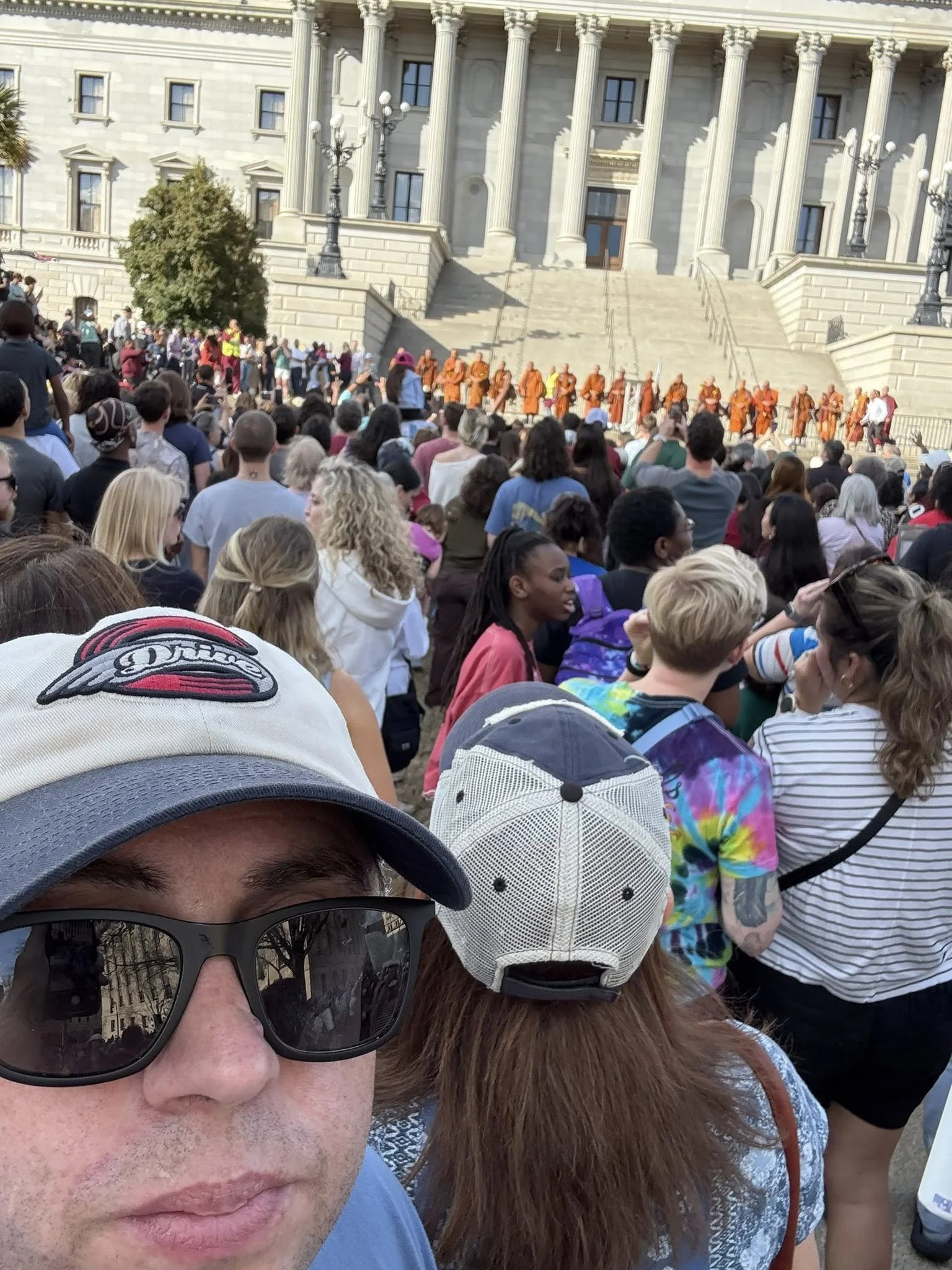
Today Is My Peaceful Day!
Ever since I began following the Venerable monks and their dog Aloka on their Walk For Peace - I have felt as though I had to see them in person. Not because of religion or politics or for any reason other than the intent. It is not to convert people or to argue policy. It’s love. It's healing. It’s peace. It’s intention. It’s purity. So simplistic but powerful. Peace starts within. It spreads to family. It spreads to community. It spreads further and further.
As I waited for the walk to reach me, I met an environmental lawyer that two weeks prior had left the firm she was working at to start her own practice. I love these stories. During the conversation I asked a typical question that I like to ask when mentoring new business owners - did you feel the burden lift?
The burden is a feeling many leaders experience, but few pause long enough to truly recognize. The moment when the responsibility is no longer yours. Not because you stopped caring. Not because the work didn’t matter. But because a chapter has closed, a burden has been handed off, or the outcome is finally beyond your control. It took a few days but she did feel the burden rise from her shoulders.
I felt my own weight lift while taking part in the Walk for Peace alongside the venerable monks. The pace was slow. Intentional. And at times quiet. In that quiet something became very clear.
So much of leadership and life is spent carrying responsibility that never really leaves us. Even when we’re off the clock. Even when no one is asking. Even when we are no longer with a company or a person. We carry it in our shoulders, in our thoughts, in the constant mental checklist running in the background.
The venerable monks reminded me how heavy that load can become without us noticing. With each step, there was a sense of letting go - not of values or accountability, but of the illusion that everything must always be held, solved, or controlled by us. The responsibility for peace, for direction, for outcomes didn’t rest on any one person’s shoulders in that moment. It was shared. It was collective. It was simply being present.
Leadership often teaches us how to take weight on. Rarely does it teach us how to set it down. And yet, moments like this remind me that clarity, calm, and perspective often come when we allow responsibility to pass - when it’s no longer ours to carry, or when it was never meant to be carried alone in the first place.
Sometimes the greatest relief isn’t the absence of work - it’s the release of ownership. And sometimes, you don’t find that release in a meeting or a milestone - but when you allow yourself to have quiet. To have internal peace. To be okay with letting go.
Today will be my peaceful day.
Going Big!
I love going big! Big initiatives because initiatives matter. But the right initiatives matter more.
Anyone can launch a project. Real leaders focus on initiatives that last - the ones that permanently change how a business operates, not just how a quarter looks.
Over the years, the most meaningful initiatives I’ve led had one thing in common - they changed the system.
$1M+ per year in packaging savings by rethinking materials, specs, and supplier strategy - not by asking people to “be careful.”
$1M+ in savings by redefining a dry ice algorithm to account for time in transit, product type, and destination temperature - validated through thermal chamber testing to dial in the exact amount needed. This one also took into account new events and the potential for civil unrest and carrier hub performance.
$1M + cost reductions through carrier optimization - matching order profiles to the right carriers instead of defaulting to habit.
$1M+ in labor savings by treating multiple facilities as a single campus - sharing labor intelligently instead of staffing each building in isolation.
$2M+ in contract analysis for out of scope work that was not being billed.
None of these were one-time hits. They became how the business worked going forward.
That’s the difference between activity and impact. The best initiatives survive leadership changes, scale as volume grows, and improve decisions long after the project ends.
If you’re choosing where to invest your time, don’t ask, “What can we fix?”
Ask, “What can we change forever?” That’s where real value is created.
Integrity As Strategy
How do you lead when things get hard? Not when the plan is working or when the numbers are green or when everyone agrees. But when the pressure is on. When the easy choice is obvious or tempting but wrong?
In those moments, integrity becomes the strategy. Do you keep the same standards when no one is watching? Do you tell the truth when it creates discomfort? Do you make the decision you’d defend later, not just the one that gets you through today?
When things get hard, people don’t look for perfection - they look for consistency. They want to know what you’ll do under pressure because that’s what they’ll plan around.
Strong leaders don’t change their values to fit the moment. They use their values to navigate it. That’s how trust is built. That’s how culture holds. That’s how you lead when things get hard.
Quality Is Not A Gimmick
I once inherited a quality team that leadership viewed as a marketing checkbox - visibly important for audits - useful for customer decks - largely disconnected from day-to-day operations. That perception was the real problem.
Quality doesn’t live in binders or badges or hiding in an office - it lives in processes, behaviors, and decisions made on the floor every day. So instead of defending the function, I redefined it.
I transitioned the team from “quality” to Operational Excellence. That meant shifting from inspection to prevention. It meant an effort to build excellence into the frontline. From audit prep to process ownership. From compliance after the fact to discipline built into operations.
The team became embedded with manufacturing, supply chain, operations, facilities, and customer service. They owned standards, root cause, continuous improvement, and accountability - not just scores.
The results followed.
What had been seen as a marketing gimmick became a world-class operational capability, delivering world-class outcomes. AIB audits of 980, SQF audits with a score of 99, ISO audits with zero non-conformities.
The biggest win wasn’t the certifications. It was the shift in mindset. Quality stopped being something we showed. It became something we did.
That’s what happens when quality isn't treated as branding - but is treated as leadership.
The Guy
For most of my career, I’ve been “the guy.”
Not the one with the flashiest title. Rarely the loudest voice in the room. You know the guy, right? The one people call when things get complicated.
The one who can cross departments without friction - operations, supply chain, manufacturing, finance, sales, customer service, compliance, marketing, human resources, tech - I’ve lived in all of them.
I learned how to build bridges where silos existed. How to translate when teams were speaking different languages. How to be the glue when growth, pressure, or change threatened to pull everything apart.
Being “the guy” means accountability without excuses. It means seeing the whole system, not just your lane. It means stepping in when ownership is unclear and staying until it’s fixed.
That role doesn’t always get the spotlight. But it’s the reason companies scale, teams trust each other, and results actually stick.
If you’ve ever been that person - the connector, the stabilizer, the one who makes it work - you know that being “the guy” isn’t about ego. It’s about responsibility. I wouldn’t trade that experience for anything.
Software Implementations
Most retention problems in operations aren’t people problems - they’re system problems.
And too often, they’re treated as an HR problem - when HR isn’t actually embedded in day-to-day operations.
In one organization, HR's idea of onboarding was giving the employee a badge and making sure paperwork was complete. This generic onboarding approach and hands-off support left managers stretched thin and new hires overwhelmed. Performance varied by site, and retention suffered.
My team built an ops-specific training and retention program, owned by operations. It included role-based onboarding with clear 30/60/90-day expectations. Training was tied directly to safety, quality, and service - not theory. Managers were trained to coach and give feedback, not just fix problems. Performance standards became visible and measurable.
Training became part of the operating rhythm, not a one-time event.
The result:
Employee Net Promoter Score Improved by 80%
Faster time to productivity
More consistent execution
Stronger frontline leaders
The lesson:
Retention doesn’t improve because HR cares more. It improves when operations takes responsibility and builds systems that help people succeed.
Retention
Most retention problems in operations aren’t people problems - they’re system problems.
And too often, they’re treated as an HR problem - when HR isn’t actually embedded in day-to-day operations.
In one organization, HR's idea of onboarding was giving the employee a badge and making sure paperwork was complete. This generic onboarding approach and hands-off support left managers stretched thin and new hires overwhelmed. Performance varied by site, and retention suffered.
My team built an ops-specific training and retention program, owned by operations. It included role-based onboarding with clear 30/60/90-day expectations. Training was tied directly to safety, quality, and service - not theory. Managers were trained to coach and give feedback, not just fix problems. Performance standards became visible and measurable.
Training became part of the operating rhythm, not a one-time event.
The result:
Employee Net Promoter Score Improved by 80%
Faster time to productivity
More consistent execution
Stronger frontline leaders
The lesson:
Retention doesn’t improve because HR cares more. It improves when operations takes responsibility and builds systems that help people succeed.
Multi-Site Scaling
I keep seeing organizations invest heavily in new tools - software, dashboards, AI - hoping they’ll magically fix performance. But tools don’t create results. People do.
You can have all the tools, but without the training they are worthless. I’ve watched teams get overwhelmed by systems they were never properly taught to use. The outcome is predictable - low adoption - workarounds - frustration - missed value.
Real transformation doesn’t come from buying the next shiny solution. It comes from teaching people why the tool matters. It comes from showing them how to use it effectively. It comes from giving them time to practice and ask questions. It comes from holding leaders accountable for capability and not just implementation.
Before investing in another tool, ask a harder question. Have we invested enough in the people expected to use it? Because the best tool in the world is useless in untrained hands.
Tools Do Not Create Results
I keep seeing organizations invest heavily in new tools - software, dashboards, AI - hoping they’ll magically fix performance. But tools don’t create results. People do.
You can have all the tools, but without the training they are worthless. I’ve watched teams get overwhelmed by systems they were never properly taught to use. The outcome is predictable - low adoption - workarounds - frustration - missed value.
Real transformation doesn’t come from buying the next shiny solution. It comes from teaching people why the tool matters. It comes from showing them how to use it effectively. It comes from giving them time to practice and ask questions. It comes from holding leaders accountable for capability and not just implementation.
Before investing in another tool, ask a harder question. Have we invested enough in the people expected to use it? Because the best tool in the world is useless in untrained hands.
A Lesson In Legos
How do you gauge your ability to communicate? When problems occur do you look at communication in your search for answers? When two team members are not getting along - how do you handle that?
Here's my approach. I use two identical sets of Legos to teach a lesson on communication. Two people sat across from each other. A screen blocks their view so neither could see what the other is building.
Round one:
One person gives instructions.
The other followed them exactly.
No questions allowed.
After 30 pieces, the screen is removed.
The result? Badly off. Technically compliant. Practically wrong.
Round two:
Same setup. Same pieces.
This time, the builder can ask questions.
The result will be dramatically better. Usually close. Sometimes nearly perfect.
Round three:
We remove the screen.
They build together.
Both can give direction. Both can ask questions.
The final build will be spot on.
The lesson is simple - one-way communication creates compliance, not alignment. Questions aren’t inefficiency - they’re accuracy. Collaboration beats instruction every time. If you want better outcomes, don’t just give clearer directions. Create space for questions. And when possible - build together.
Seat at the Table
During my career, I've been good at expanding the table. For me this is inviting the next layer of leadership to meetings were decisions are made. I would counsel those invited to take advantage of the invite. They were given ground - don't give it back - earn the seat and get invited to the next meeting.
I'd tell them that they do not earn the seat at the table once. They earn it every meeting. Being invited isn’t the finish line - it’s the starting point.
Earning your seat is: showing up prepared, not just present; understanding the decision that needs to be made; bringing insight, not narration; challenging assumptions respectfully, knowing when to speak and when to listen.
Titles might get you into the room but credibility keeps you there. The people who consistently earn their seat don’t try to dominate the conversation. They elevate it. They add clarity, reduce noise, and help the group move forward.
If you leave a meeting and no one’s thinking differently because you were there, that’s feedback - even if no one says it out loud.
Every meeting is another opportunity to earn the seat again.
Quiet is a Competitive Advantage
I start my day before most people come online. Not because I’m trying to “outwork” anyone- but because quiet is a competitive advantage.
Before the pings, the meetings, the Slack messages, and the fire drills, there’s space to think - to plan - to decide what actually matters today instead of reacting to what is loudest.
That early window is where priorities get set. It's where trade-offs get thought through. It's were decisions get clearer.
Once the day gets noisy, you’re managing inputs. Before it does, you can design outcomes. It’s not about waking up early for the sake of it. It’s about protecting uninterrupted thinking time - however that fits your schedule. Because the quality of your day is often decided before the first meeting starts.
No Hot Take
I stared at the screen today with nothing clever to say. No insight. No lesson. No “hot take.”
So this is the post.
Not every day produces wisdom worth sharing. Not every moment needs to be optimized for engagement. Sometimes the most honest thing you can say is that you’re still thinking.
Work happens in the quiet spaces too - between decisions, between posts, between certainty and clarity.
Today’s post is about not having one.