Resolutions
Every January, my feed fills up with New Year’s Resolutions.
New year, new you. New habits. New mindset. New buzzwords.
So, in the spirit of the season, here are a few of my resolutions:
- I resolve to not pretend January 2nd is “business as usual” when half the org is still on PTO.
- I resolve to stop calling the same old initiative a “transformation” just because we added a slide with arrows.
- I resolve to finally finish a strategic plan before the market changes again (ambitious, I know).
- I resolve to ask “what problem are we actually solving?” before approving another spreadsheet or dashboard.
- I resolve to not be shocked when Q1 forecasts don’t survive their first encounter with reality.
And my personal favorite:
- I resolve to stop believing that this year will be less chaotic than the last one.
Because if supply chain has taught me anything, it’s that plans are temporary. Disruptions are forever.
Happy New Year to everyone confidently setting goals they’ll be forced to revisit by February.
Year In Review
As the year wraps up, it feels mandatory to post a “Year in Review.” So here we are.
This year was a masterclass in making plans - and then immediately changing them. Assumptions aged like milk. Priorities shifted. And just when things felt stable, the universe reminded me that confidence is not the same thing as certainty.
A few highlights (and humbling reminders) -
“Just one more quick change” is never just one more. The best strategy deck still loses to reality by Tuesday. Urgent things will always try to impersonate important ones. Transparency saves time. Silence creates meetings. Lots of meetings (have I told you how much I hate meetings?). And leadership is less about having the answers and more about owning the outcomes - especially when the answer was wrong.
The real win this year wasn’t perfection (that was never on the table). It was working with people who stayed accountable, adaptable, and occasionally sarcastic enough to keep things fun.
Heading into the new year, I’m not chasing resolutions or buzzwords. Just clearer thinking, fewer “fire drills,” better questions, and teams that trust each other enough to say, “This isn’t working - let’s fix it.” Oh and lesser meetings - because if I have not said it enough - I hate pointless meetings.
Grateful for the lessons, the people, and the reminders that progress rarely looks clean in real time.
See you next year.
Geopolitics in Supply Chain
2025 saw a seismic shift in the impact of geopolitics on Supply Chain. It was always present but it became far more magnified this year. Major changes in global trade and industrial policy had ripples that greatly impacted businesses and consumers. Nations mandated domestic sourcing and production while tariffs became a bigger disruption than most would have expected.
As supply chain professionals, we often talk about resilience, risk mitigation, and visibility - but these developments highlighted something deeper. The geopolitical dimension of supply chains is no longer theoretical - it’s operational. Some of my takeaways from this past year - geopolitical strategy influences sourcing decisions.
This isn’t just about tariffs or trade disputes - it’s about national and international industrial policy reshaping the architecture of where and how products get made. Diversification matters more than ever.
Companies reliant on specific regions or single suppliers for critical inputs now face heightened risk. Strategic diversification is a competitive differentiator. Visibility and agility are a must. When sourcing teams can see supplier risk early and have contingency playbooks ready, the organization can move faster and with more confidence.
Collaboration with government and industry partners is a must. Often the smartest supply chain strategies happen with policy shifts.
My takeaway? Think beyond optimization - think sovereignty, resilience, and strategic partnerships. In 2026 and beyond, supply chains will be shaped not just by markets but by policy and purpose.
Reflections
As the year comes to an end, I’ve been reflecting. Each day on something different. Something that mattered. Something that was meaningful. Today's is about people.
I still take calls and texts from people I worked with - some that worked for me - some that worked beside me - some that I worked for - and some that I have known outside of professional life. Those are interactions vary greatly. Sometimes it’s advice on a tough decision. Sometimes it’s encouragement during a hard season. Sometimes it’s just checking in. Sometimes it's career advice. Sometimes it's just someone to listen.
The companies have changed. The roles have changed. The connection hasn’t. Mentorship, friendship, partnership doesn’t end when you stop working together. If anything, time strengthens it. Without agendas or org charts, what remains is trust, shared experience, and a genuine willingness to be there for one another.
As the year closes, those conversations are a reminder of what lasts. The real measure of leadership shows up long after the work is done - in the relationships that continue, year after year.
Racking Risk
One of the most overlooked safety risks in a warehouse is right in front of us every day - the racking.
Bent uprights. Missing pins. Impact damage from forklifts. Loads stored higher or heavier than the rack was designed to handle. These things tend to blend into the background - until they don’t.
Racks aren’t just steel and bolts. They’re load-bearing systems that directly protect the people working beneath and around them. When their integrity is compromised, the risk isn’t theoretical. It’s immediate.
Paying attention to racking means regular inspections, clear weight ratings, prompt repairs, and the discipline to take locations out of service when something isn’t right. It also means training operators to understand that a “small hit” isn’t small at all.
Warehouse safety isn’t only about PPE and procedures. It’s about respecting the infrastructure that holds the operation together - and making sure every employee goes home the same way they arrived.
Don’t Chase Every Opportunity
I once worked with a CEO who was determined to pursue a customer that required full manufacturing, R&D, sourcing, and deep technical expertise - capabilities our organization simply didn’t have.
The leadership team was aligned in advising against it. We were clear about the gaps, the risks, and the reality of what it would take to execute well. The message was consistent - this wasn’t a fit.
But the pursuit continued anyway. Months passed. Time, energy, and credibility were spent trying to bend the organization into something it wasn’t. Eventually, the opportunity was walked away from.
The cost wasn’t just internal. The potential customer lost valuable time they couldn’t get back. And our organization lost something harder to recover - integrity. Saying “yes” when you know you can’t deliver is far more damaging than saying “no” early and honestly.
Leadership isn’t about chasing every opportunity. It’s about knowing who you are, what you can truly do well, and having the discipline to walk away when it’s not aligned.
Back in Rhythm
Coming back to work after the holiday can be tough. The inbox is full. The calendar is suddenly crowded. The quiet from a few days ago is gone.
Operations start humming again - returns to process, inventory to reset, plans to execute.
There’s always a moment of reset - where reflection meets reality and finishing strong means one more week until a new year.
No big speeches needed. Just sleeves rolled up, priorities clear, and teams getting back into rhythm.
Here we go.
Christmas Eve in Supply Chain
Christmas Eve in supply chain feels different.
The factory floor is quiet. The warehouse sounds are of hushed voices. Forklifts parked. Conveyors still. Dock doors closed that, just days ago, never stopped moving.
That silence is not emptiness. It’s the result of weeks and months of planning, long shifts, and controlled chaos finally giving way to calm. Out on the roads - the last deliveries are still being made. Drivers finishing routes. Packages finding their destination just in time.
No spotlight. No applause. Just commitment. This is the moment most people never see. When the noise fades and the work is done. If you’ve worked a warehouse floor or supported logistics during peak season, you know - that quiet is earned.
To the teams who planned, manufactured, picked, packed, loaded, dispatched, and delivered - this calm is your victory lap.
Merry Christmas Eve to everyone in supply chain.
Be Contrarian
A few years ago, I was given what I believe to be the ultimate compliment - "you are a disruptor."
Being a Disruptor doesn’t mean being loud. It means being contrarian. One of my personal core values is Being Contrarian. Not for the sake of disagreement - but because progress rarely comes from nodding along with “the way it’s always been done.”
In operations and supply chain, the default answer is often "That’s standard.” “That’s how the system works.” “Everyone does it this way.” And my personal favorite (sarcasm), "That's how we've always done it."
Being contrarian means asking: Should it work this way? Who benefits from this process? What problem are we solving or what are we protecting?
Disruption doesn’t always look like tearing things down - sometimes it looks like challenging assumptions that no longer fit the business - questioning metrics that reward activity instead of outcomes - saying the uncomfortable thing early (before it becomes an expensive issue later).
Contrarian thinking isn’t about ego. It’s about responsibility. It's not saying it in a harsh way or in a demeaning way. If you see a better path and stay silent, you’re not being aligned, you’re being complicit.
The best leaders I’ve worked with don’t want agreement. They want clarity. They want someone willing to push back with data, experience, and intent.
That’s how real disruption happens. Quietly. Thoughtfully. Relentlessly.
The Ultimate Supply Chain Operator - Ho Ho Ho
Santa just may be the ultimate supply chain operator. He probably deserves to be in the Supply Chain Hall of Fame. Right up there with the person that invented retractable box cutters, the electric pallet jack, and self leveling docks.
One-night delivery window. Global distribution. Zero tolerance for failure. Demand forecasting? Locked in a year ahead. Inventory management? Every Barbie, Lego, and RC car accounted for. Last-mile delivery? No carriers, no backups, no excuses. And when something goes wrong? No press release. No blame. Just execution.
Santa doesn’t argue about constraints - he designs around them. He plans early, builds redundancy (reindeer and magic - remember Rudolph was not even an A Player), and trusts a highly specialized workforce.
Most impressive of all? When Christmas morning is a success, no one thinks about the operation behind it. They just enjoy the outcome. That’s real operational excellence.
Santa is proof that when planning, execution, and accountability align, even the impossible looks easy.
Confidence Without Competence
Early in my career, I was told to race to the top - work harder than everyone else - say yes more - outperform - climb.
And I got there - or close enough to see it clearly - I realized something unsettling. Not everyone at the top belongs there. You see decisions disconnected from reality. Egos can be louder than results. There was confidence without competence.
That moment can either be discouraging or clarifying. Because I learned that titles do not equal leadership. Position doesn’t guarantee perspective. And the climb itself doesn’t automatically produce wisdom.
The real question becomes do you want to be at the top or do you want to be effective? Some of the best leaders I’ve worked with weren’t the loudest in the room or the highest on the org chart - they earned trust - they understood the work - they made others better.
If you’ve ever looked up and thought, “How did we end up here?” - you’re not alone. Let that realization sharpen your standards, not dull your ambition. Climb with integrity. Lead with substance.
The Glue
Some of the most valuable people in any organization do not fit neatly into a job description. They’re the ones who can step into multiple roles when needed - translate strategy into execution - jump from ops to finance to customer conversations - see how one decision has impact upstream and downstream.
They are the glue. Not because they’re doing everyone else’s job - but because they understand how the pieces fit together. They see what others do not.
In fast-moving organizations, especially in supply chain and operations, this versatility is a force multiplier - problems get solved faster - silos break down - teams stay aligned when things get messy.
These people often don’t get the spotlight. Their work shows up as things just working. The best leaders recognize and protect them. The smartest organizations intentionally develop more of them. Because when growth accelerates or disruption hits, it’s the glue players who keep everything from coming apart.
Can’t You Just…
“Can’t you just…?”
That question gets a bad reputation in operations - and for good reason. It’s usually followed by something expensive, complex, and wildly underestimated. But every once in a while, it opens a door.
Years ago, a simple “can’t you just…” conversation turned an ecommerce fulfillment warehouse into something much more - a true partner to its clients.
"Can't you just put a phone on a desk and answer it?" And we did. That phone would ring and we'd run across the warehouse, hurdle boxes, and answer it. Then a second phone, a third, and finally the realization that we had a call center and needed a real technology solution. And so our call center was born.
"Can't you just take one of each item, bundle it together, and ship it to Amazon?" You know we can. And off to the races on an Amazon kitting and compliance value-add service.
"Can't you just take two nuts and put it onto one bolt?" Sure. We can do that. And that gave birth to a light manufacturing value-add service.
"Can't you just collect our mail, mobile deposit our checks, scan, and email the correspondence?" Not a problem. And suddenly we had scanning and back office services.
Not because it was easy. Not because it was obvious. But because we stopped answering the question with an automatic no - and started asking how. What would it take? What capabilities already exist? What problems could we solve if we connected the dots differently?
That mindset changed our business into a strategic partnership that was so sticky that clients thought of us as them.
“Can’t you just…?” can be dangerous. But in the right hands - it’s also where innovation starts. The difference is whether you dismiss it or design for it.
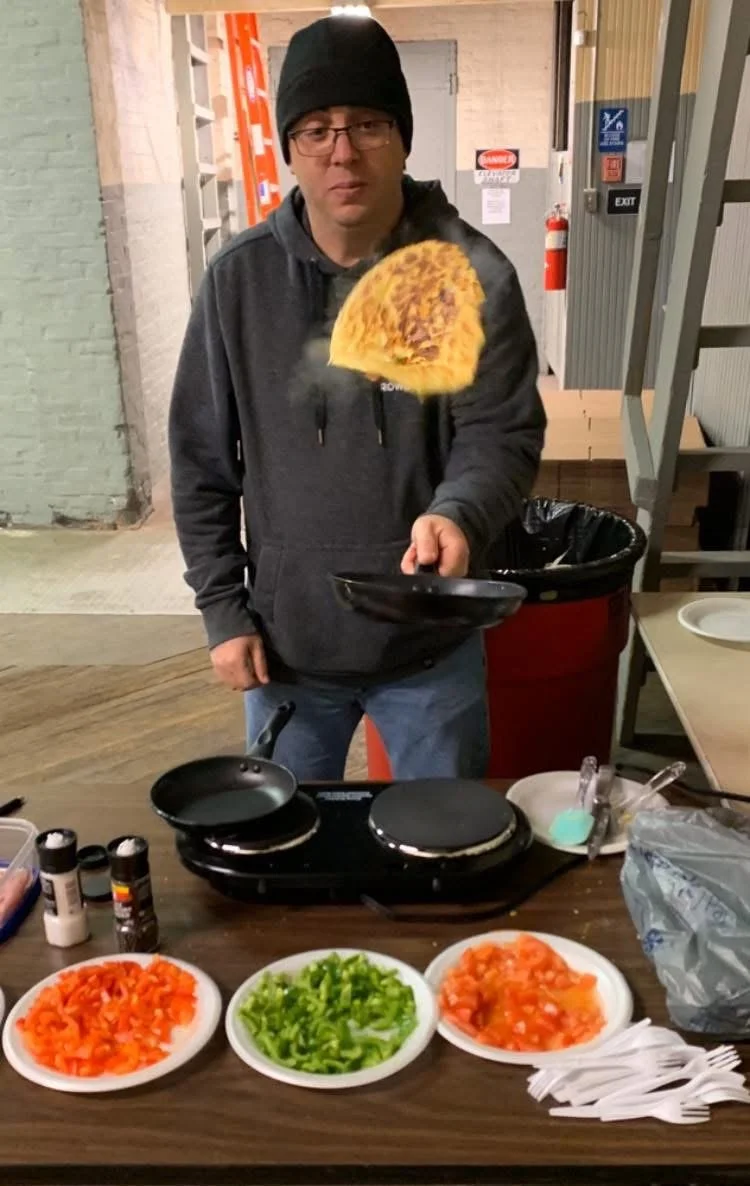
Eggs, Heat, and Trust In The Flip
Throwback Thursday!
Sometimes leadership looks like strategy and spreadsheets. Sometimes it looks like eggs, heat, and a little trust in the flip.
This was a show of appreciation for a team that didn’t just meet expectations - they blew past them. Long days. Tough calls. No shortcuts. Just execution.
So instead of another meeting or a generic “thank you,” I fired up the stove and cooked omelets for the team. Why? Because appreciation doesn’t have to be complicated - it just has to be genuine. Could those two hours have been spent moving the business forward in a different way? Sure it could have. But these two hours boosted morale, showed appreciation, broke down barriers, and fed hungry bellies!
This photo of me mid-omelet flip isn’t about cooking skills. It’s about showing up for the people who show up every day. It’s about recognizing effort, momentum, and results while the win is still fresh.
Great teams deliver outcomes. Great leaders make sure those outcomes are celebrated.
Trauma Bonds
The trauma bonds of Supply Chain are strong.
I caught up with a former colleague and within minutes we were right back in it. War stories from operations and supply chain have a way of picking up where they left off - the need for immediate solutions - the “this will never work” moments that somehow did - the decisions made with imperfect data and real consequences.
What struck me wasn’t the chaos or even that chaos exists in all organizations (sometimes small and sometimes large) - we all remember that. It was the shared respect for the work and the people who did and do it.
Operations teaches you things no classroom or seminar ever will - how to stay calm when everything is loud - how to solve problems that don’t have clean answers - how to trust people when the pressure is real.
Those conversations are a reminder that supply chain isn’t just systems and spreadsheets. It’s judgment, grit, and relationships built in the middle of the mess.
Always good to reconnect with someone who understands the work - because once you’ve lived it, you don’t need to explain it.
Head Up and Eyes Ahead
“Head up. Eyes ahead.”
I’ve used that line for years because it cuts through the noise. In supply chain and operations, pressure is constant. Misses happen. Costs spike. Something always breaks.
“Head up” means don’t spiral. Get perspective. See the whole system.
“Eyes ahead” means don’t dwell. Learn fast. Move forward.
The best leaders don’t panic and they don’t rewind. They don't unravel. They stay focused, decisive, and forward-looking when it matters most.
No drama. No dwelling. Just execution.
Head up. Eyes ahead.

Vacations create perspective
There’s something about returning to work after a vacation that hits a little differently. This trip was to Disney World.
A few days of early mornings, late nights, long lines, big smiles, and zero emails. Total immersion including me trying to join The Country Bear Jamboree. The kind of break that reminds you how important it is to be fully present - wherever you are.
What struck me most wasn’t just the magic (though Disney does that well). It was the execution. Despite the lines - everything runs on time. The experience is intentionally designed. Problems are solved before most people notice them. Thousands of moving parts, flawlessly orchestrated. It’s a masterclass in operations, leadership, and customer experience.
Coming back to work refreshed, re-centered, and reminded that the best organizations don’t rely on magic. They rely on discipline, systems, and people who care deeply about the outcome.
Vacations create perspective. Perspective makes us better leaders.
Now, back to it.
Vacation
I'm on vacation - I've pre-scheduled this post because...well...I can, I guess.
I'm reminded why stepping away isn’t a break from work - it’s fuel for it. For most of my career, I’ve been wired for urgency. Solve the problem. Keep the operation moving. Be available. Be responsive.
But there’s something powerful about pressing pause and spending uninterrupted time with the people who matter most. No meetings. No metrics. No deadlines.
Just family, laughter, and the kind of moments you can’t schedule.
Here's what I know:
The business will still be there when I get back.
My team will become stronger when they get to lead without me.
And I hope to return with more clarity, energy, and perspective than I had when I left.
Great leaders don’t just work hard - they recharge intentionally.
Family time isn’t a distraction from success. It’s part of the formula.
I hope to come back refreshed, grateful, and reminded that the reason we work so hard is to create a life worth stepping away for.
Please enjoy the pause from my regularly scheduled programming.
Squeeze The Air
It drives me crazy to walk through a warehouse and see an inefficient use of space. One of the most valuable things you can do is simple - Squeeze The Air.
Everyone talks about needing more space - more racking - more square footage - more buildings. But the truth is, most warehouses aren’t running out of space. They’re running out of usable space.
Look up. All that empty air above the pallet? Above the case pick slots? Above the reserve locations? That’s capacity you already own - you’re just not using it yet.
When you properly engineer vertical space, you unlock:
Higher storage density without expanding your footprint
Better cube utilization and smarter inventory positioning
Shorter travel paths because product is stored closer to the action
Lower cost per unit stored (the metric most operations overlook)
I’ve seen teams go from “we need a bigger building” to “we have room for another six months of growth” simply by optimizing vertical clearances and slot heights.
The best operators don’t just manage floor space. They manage airspace. If you want a more efficient warehouse - don’t start with construction. Start with a tape measure and the space right above your head.