Remove the Poison
Failure doesn’t always come from bad decisions. Sometimes it comes from good intentions held for too long.
My biggest failure as a leader wasn’t a missed forecast, a bad hire on paper, or a strategic misstep. It was this failing to see - or maybe failing to accept - that someone on my team was poisonous.
I saw talent. I saw potential. I believed that with enough coaching, context, and care, I could help reform the behavior. So I looked past the warning signs.
I rationalized moments that should’ve stopped me cold. I told myself patience was leadership. I told myself that if I put the effort - if I poured into them - that I could change them.
What I didn’t fully understand at the time was the cost. While I focused on saving one person, the team was absorbing the damage. Trust eroded. Energy drained. High performers questioned whether standards mattered.
By the time I acted, the harm was already done.
That failure changed how I lead. I still believe in coaching. I still believe people can grow. But I understand that protecting the team is the primary responsibility - not rescuing one individual at everyone else’s expense.
Some behaviors aren’t problems to solve. They’re signals to act. Failure taught me that leadership isn’t just about empathy and patience. It’s about courage - especially when action feels uncomfortable.
If you’ve made this mistake too - you’re not alone. Learn from it. The team is always watching.
Being Easy To Partner With
One of the most underrated competitive advantages in business is being easy to partner with.
Vendors remember it. They feel it. And they respond to it.
The best partnerships aren’t built on squeezing margin or flexing contracts. They’re built on clarity, consistency, and mutual respect.
It starts with defining clear expectations instead of moving targets. It gets better with honest forecasts instead of wishful thinking. It progresses with fast decisions instead of endless maybes. And it gains trust with paying on time (this one matters more than people admit). It goes next level when you take their business into account and understand that your expectations are part of their business - not all of it.
When vendors trust you, they share capacity before it’s public. They flag issues early instead of hiding them. They bring you ideas, not just invoices
In supply chain and operations, you don’t win alone. You win through the ecosystem you build around you. Don’t ask, “How much can I extract?”
Ask, “How do we win together?” Because when things get tight - and they always do - vendors go the extra mile for partners who’ve been fair, prepared, and human.
Be the customer vendors want to answer the phone for.
The One
There’s a role no one puts in a job description. Being the person everyone goes to. The one they bring their problems, their insecurities, theirs wins and losses, their fears they won't say out loud in meetings. You become the safe place. The sounding board. The steady presence when things feel uncertain.
It’s an honor - and it’s heavy.
Because while you’re carrying all of that, you’re still expected to make hard decisions, deliver results, lead with clarity, keep moving forward.
Most people don’t see that weight. They just see the calm. What they don’t realize is that absorbing emotion is work. Holding confidence for others while managing your own doubts takes energy. Listening deeply while staying objective is a skill you build over time - often the hard way.
If you’re that person, here’s the reminder - you don’t have to be made of steel. You’re allowed to step back. You’re allowed to put the weight down occasionally.
Leadership isn’t just strategy and execution. Sometimes it’s emotional labor - done quietly, consistently, and without applause.
To the people who are “the one” in their organizations - I see you.
Uninterrupted Minutes
Coffee in hand. A book I haven’t picked up in far too long. And the quiet kind of pause you don’t get during the week.
Here in Greenville, SC, we’re waiting on a snowstorm today. The flurries have just started. Nothing dramatic yet. Just enough to slow me down long enough to reminisce about the crazy Northeast winters - before the realization that I do not miss them.
There’s something grounding about these mornings. No urgency. No agenda. Just a little reading, a warm cup, and watching the world outside change pace.
It’s a few uninterrupted minutes, a good book, and permission to sit still. Snow or not, this is a good way to start the day.
Reliability through disruption
The recent East Coast winter storm - one that knocked out power, shut down travel networks, and challenged logistics operations from warehousing to last-mile delivery - isn’t just “weather news” anymore. It’s become a supply chain reality we have to account for.
And now another powerful system is forecast to follow, with snow, high winds, coastal flooding and bitter cold moving up the I-95 corridor. Experts are even warning of nor’easter and bomb cyclone conditions that could further limit mobility and freight movement this weekend.
We’re already seeing:
- Port, rail and surface freight delays as operations adjust to extreme conditions and restricted access.
- Air cargo and parcel network disruptions, with major carriers warning of extended delays and limited service.
- Trucking and ground transport challenges, from icy corridors to staffing and safety constraints.
This isn’t an isolated event - it’s a reminder that weather volatility has become a structural risk for the supply chain, not an occasional outlier.
Planning for these conditions means not just reacting to the last storm, but building resilience into routing, capacity planning, and customer communication.
For supply chain leaders, this week’s developments are a prompt to assess:
- Do our winter contingency plans truly reflect today’s weather magnitude?
- Are we modeling for cascading impacts across modes and nodes?
- How are we communicating delays and expectations upstream and downstream?
Operational excellence in calm weather is easy. Reliability through disruption is what defines competitive advantage today.
Stay safe, stay flexible, and keep moving the chain forward.
Focus on Execution
Throw Back Thursday
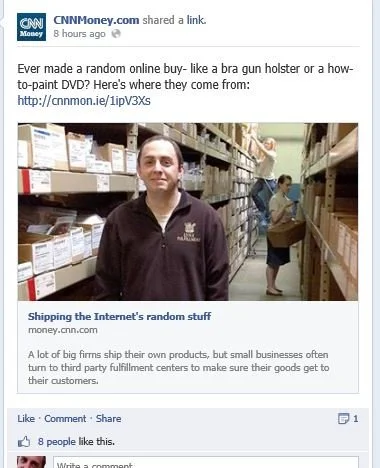
I still remember the moment my third-party fulfillment company received the call to appear on CNN Money.
The story was titled: “Shipping the Internet’s Random Stuff.” It was exciting -not because of the headline, but because of what it represented. That recognition wasn’t the result of a single big win or a lucky break. It came from long days, tight margins, scrappy problem-solving, and doing unglamorous work really well - over and over again.
Packing orders accurately. Meeting our SLA's. Fixing mistakes without excuses. Taking care of customers most people never see. And doing it so well that we were never seen - until that story.
Public recognition is often portrayed as sudden. In reality, it’s usually the byproduct of consistency when no one is watching.
That article may have been a moment of validation - but it was built on years of effort that never made a headline. Most meaningful recognition works that way. It shows up late. It shows up quietly. And it only finds teams that were already doing the work anyway.
The lesson stuck with me: focus on execution first. The spotlight, if it comes at all, follows the grind - not the other way around.
The gray area
Not every decision comes with a clear right or wrong answer.
Some of the hardest moments in leadership live in the gray - where data is incomplete, opinions differ, and waiting feels just as risky as acting. That’s ambiguity.
In those moments, progress doesn’t come from certainty. It comes from judgment. It comes from testing assumptions. You choose a direction knowing it may need to change. You commit anyway because indecision has a cost.
Strong leaders don’t pretend the answer is obvious. They’re transparent about trade-offs and clear about intent. When there’s no perfect choice, the goal isn’t perfection. It’s forward motion with accountability.
Ambiguity doesn’t disappear with more meetings or more slides. It gets resolved by thoughtful action, learning, and adjustment.
Leadership isn’t about always being right. It’s about moving forward when the answer isn’t clear and owning the outcome either way.
Co-manufacturing and relationships
Co-manufacturing in the meat industry isn’t just outsourcing production. It’s a math problem wrapped in a relationship.
You don’t send pallets of finished goods - you send raw material. What comes back is shaped by quality, trim, moisture loss, cook loss, handling, and yield discipline. That’s where many partnerships struggle.
If you’re not tightly aligned on expected yield by SKU, where loss is acceptable vs. preventable, and how variances are measured and reported
you’ll argue about inventory instead of improving performance.
In meat, yield is margin. A few points of unexplained loss can erase profitability faster than pricing ever will.
Strong co-manufacturing relationships treat yield as a shared responsibility, not a finger-pointing exercise. The best partners will define yield assumptions upfront, track raw-to-finished conversion transparently, and reconcile often.
The companies that win don’t ask, “Did we get the product back?” They ask, “Did we get the yield we planned for and do we both understand why or why not?” Because in meat co-manufacturing, trust is built in ounces, not in words.
Why do you do it?
I was asked - Why do you do it? Simple question with so many possible answers. But after reflecting - I have my answer.
I do it for the moments no one posts about.
I do it for the first day a team member realizes they’re not “just a a team member" - they’re leading a project, influencing decisions, and earning the respect of seasoned operators.
I do it for turning worn-out buildings into productive operations. For taking chaos, constraints, and half-working processes and turning them into something that actually hums.
I do it for the uncomfortable conversations. The stockout explanations. The margin pressure. The systems that should work but don’t - yet.
I do it because complex supply chains are puzzles worth solving. Because when communication is messy, data is incomplete, and the stakes are real, leadership actually matters.
I do it to build teams that don’t need heroics to win - just clarity, trust, and accountability.
I do it because there’s nothing more satisfying than watching people and processes level up at the same time.
That’s why I do it.
Customer Lifetime Value is an operational outcome
Customer Lifetime Value isn’t just a marketing metric. It’s an operational outcome.
Every late shipment, partial fill, damaged box, or “we’ll get back to you” moment quietly chips away at LTV. And every on-time delivery, accurate order, and effortless return does the opposite.
Supply chain is where promises either become habits or churn. Inventory accuracy determines whether customers trust “in stock.” Fulfillment speed determines whether they come back. Packaging, substitutions, and communication determine whether they recommend you or replace you.
You don’t build lifetime value with one great experience. You build it with consistent, boring operational excellence at scale.
Don’t ask, “What does this save us?” Ask, “What does this cost us over the customer’s lifetime?” Because in the end, LTV isn’t owned by Marketing or Sales. It’s protected or destroyed by Operations.
Weather is a risk event
For those of us in supply chain, weather isn’t just a forecast - it’s a risk event. It impacts drivers, warehouses, ports, plants, and the people holding all of it together.
A reminder as this weather event continues and conditions deteriorate:
No load is worth a life. No service level justifies unsafe roads. No recovery plan works if your people aren’t okay. Delays will happen. Networks will flex. That’s what resilient supply chains do.
Great operators plan for disruption. Great leaders protect their teams during it.
If you’re in the storm’s path - slow down, stay home if you can, and check on your people. Stay safe out there.
Pulse Check
Pulse Check.
How are you feeling heading into the weekend?
No fixing. No optimizing. Just a moment to be honest. Go ahead - be vulnerable!
I'll make a comment about how I'm feeling. I challenge you to do the same.
Sometimes the most productive thing we can do is acknowledge where we actually are before we reset and do it again on Monday.
Hope you find a little space to recharge.
The Intern
Every now and then, an intern shows you what potential really looks like.
One summer, I had an intern who set herself apart almost immediately. Not because she talked the most - but because she did the work.
She jumped into real projects without hesitation. She built data models that actually helped decisions get made. And she earned the respect of operations managers and frontline team members through competence.
That doesn’t happen by accident. She asked smart questions. She listened before offering solutions. She led from the front. And she treated the role like an opportunity, not a placeholder. Great interns don’t wait to be managed. They look for ways to add value.
She reminded me that talent shows up early - and when it does, it’s obvious.
If you’re wondering what separates a good intern from a great one - it's
curiosity, ownership, and the courage to step into real work. Every leader hopes to have that intern on their team.
Clarity Takes Time
Time is often treated like something to spend. And managers often say things like - don't waste your time on... - focus on... - why did you spend time on...
The use of time is important but I'd argue that using time for clarity is an incredible use of it. The best leaders use time for clarity. They don’t rush decisions just to feel productive. They invest time upfront to align on intent, ownership, and outcomes - so execution doesn’t unravel later.
Clarity takes time - time to ask the right questions - time to remove ambiguity - time to make sure everyone hears the same message. Skipping that step doesn’t save time. It just pushes the cost downstream into rework, meetings, more meetings, frustration, and meetings about being frustrated.
When time is used well, teams move faster after the decision. When it isn’t, everyone stays busy without moving forward. Time spent creating clarity isn’t overhead. It’s one of the highest-return investments a leader can make.
Today is the Day!
I've had the honor of speaking at numerous universities and colleges about a range of topics including entrepreneurship, business management, supply chain, marketing, and the impact of big box on small town Main Streets. I have always tried to recycle the following into each of those presentations:
Today is the day. Not tomorrow. Not next quarter. Not after one more meeting, one more slide, one more “alignment” conversation. Today.
The strategy doesn’t get clearer by waiting. The risk doesn’t get smaller by delaying. The gap doesn’t close itself.
Most breakthroughs don’t come from perfect plans - they come from a decision to move, learn, and adjust in real time. Send the email. Make the call. Have the hard conversation. Start the thing you’ve been talking about for months. Momentum is created, not scheduled.
Removing Emotion
One of the hardest leadership skills to learn is making decisions without emotion. Not ignoring emotion - but not letting it drive the result.
When decisions are emotional, the loudest voice wins. Short-term relief overrides long-term impact. Data is secondary.
Unemotional decisions are grounded in facts, trade-offs, and consequences. I'm not advocating for being cold or detached. I'm suggesting that removing emotion creates enough distance to ask better questions. What problem are we actually solving? What happens if we do nothing? What can be undone and what cannot?
The best leaders feel deeply. The can be emotional. They just don’t make decisions impulsively because calm decisions build trust. Consistent decisions build credibility. And in moments of pressure, clarity - not emotion - is what moves organizations forward.
Sunday Mornings
Sunday morning ritual.
Same Starbucks. Same order. Same quiet moment before the week starts asking questions.
It’s one of the few times the world slows down just enough to think clearly. No meetings. No spreadsheets. No urgency disguised as importance. Just a cup of coffee and a little perspective.
These small routines matter more than we admit. They create space to reflect, reset, and remember that leadership isn’t only built in boardrooms or warehouses - it’s built in the pauses between them.
By Monday morning, the pace will pick up again - it always does. But for a few minutes on Sunday, coffee in hand, it’s enough to simply be still and get ready for what’s next.
Character Building
Nothing builds character like explaining an Out of Stock when the inventory report says you’re overstocked.
Girl Scout Cookies
Unless you are selling Girl Scout Cookies - No Soliciting.
If you’ve messaged me in the last 30 days, there’s a strong chance you’ve offered me one of the following:
• Franchise ownership opportunities
• Resume writing services
• “Guaranteed” lead generation
• A revolutionary AI tool that will “change everything”
• Something you promise is definitely not spam
It feels like my inbox has been reclassified as a digital flea market. At this point, the volume is approaching early-2000s Nigerian prince levels. The only difference is he wanted to give me money, and you want me to send you some.
To be clear - I’m not looking to buy a franchise - I’m not outsourcing my résumé - And if I was ready to change my life, it probably wouldn’t start with a cold email that begins with “Hope this finds you well.”
I do admire the hustle. Sales is hard. Rejection is real. And someone, somewhere, absolutely needs what you’re selling. Just…maybe not everyone. Especially not before coffee.
If nothing else, thank you for reinforcing the value of a strong spam filter and reminding me that some traditions never die.
Happy selling. Happy scrolling. And please…stop “circling back.”
From Worn Out to New Life
Throwback Thursday: Taking a former meat packing plant and turning it into a modern ecommerce fulfillment center built for the cold chain.
When the mandate was to find a facility to support 5x growth but keep the cost below market - you tend to get creative. When you can tie that creativity and mandate into revitalization - it's a big win.
It was a full gut and rebuild - freezer, cooler, packing areas, dry storage, offices, training space, redesigned docks, and a custom CO₂ removal system to safely support dry ice at scale.
But beyond the construction, there was something more meaningful happening - I was giving new life to something worn out. If you know me - you know that I see what others cannot. I see the value in what is deemed unworthy - buildings, systems, people.
Some lessons from this project:
- Buildings dictate behavior. If a space is tired, inefficient, or unsafe, it quietly teaches bad habits. Thoughtful design restores discipline by default.
- Design for reality, not nostalgia. Old facilities weren’t built for ecommerce, cold chain, or scale. Honoring the past doesn’t mean being constrained by it.
- Safety and efficiency grow together. Modern ventilation, dock flow, and temperature control didn’t slow the operation down - they made it safer, faster, and more humane.
- Renewal is a leadership choice. Revitalizing a worn-out building mirrors what good leaders do with teams and systems: remove friction, invest intentionally, and create conditions where performance can return.
This didn’t just repurpose a facility. It restored purpose, reduced risk, and built future capability into old walls.
Second chances!