Uncomfortable Truth
Unpopular Opinion Incoming!
The most interrupted person in your building is probably your best one. And leadership is almost certainly the reason why. Watch who people go to when they have a quick question. A quick favor. A quick thought that couldn't wait until after lunch.
Watch whose doorway has the most traffic. Whose Slack notifications never stop. Whose focus time gets consumed before it ever really starts.
That person isn't struggling because they can't manage their workload. They're struggling because everyone else's lack of planning keeps becoming their emergency. And somewhere along the way the organization quietly decided that was acceptable.
Here is what nobody wants to say out loud.
Every time a leader fails to develop their team's ability to solve problems independently - they create an interruption tax on the one person who can. Every time a manager escalates something they should have handled - they make a withdrawal from the same account. Every time "just ask so and so" becomes the answer instead of actually building capability in the people asking - the tax compounds. And the invoice always goes to the same person. The high performer.
And just like that the deep work is gone. The groove they spent forty five minutes building evaporates in ninety seconds. And they start over. Then we wonder why they seem disengaged. Why they're staying late. Why they're starting to look like someone who is carrying more than their share. They are. Just not in the way anyone is measuring.
Here is the most uncomfortable version of this truth. If your best people are always accessible - you haven't built a capable team. You've built a dependency, dressed it up as collaboration, and judged based on your idea of output.
Protect the high performers. Not from the work - from the organizational failures that keep landing on their desk disguised as quick questions. That is where your capacity is going. And until someone names it - it will keep going there.
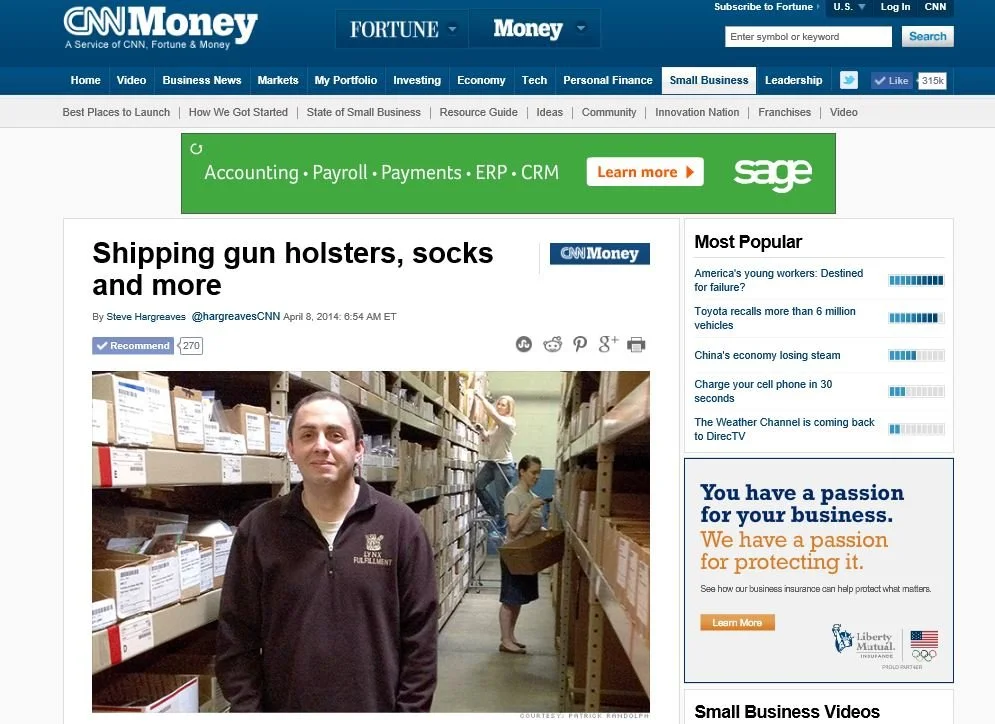
Recognition For The Work
Throwback Thursday - 2014
A reporter from CNN Money called the office. He had heard about a small fulfillment operation in Western New York that was doing something worth writing about. A little company called Lynx Fulfillment that had built a reputation for taking care of small and mid-sized businesses the way the big guys never would.
I remember thinking - how did CNN find us. The answer was simple. We were doing the work. Quietly. Consistently. Without a massive marketing budget or a national footprint or a brand strategy beyond - take care of every client like they are your most important one.
Word travels when you do things right. That article meant something to me then. It still does now. Not because of the press. But because of what it represented. A team that showed up every day and cared about what they were building. Clients who trusted us with their business. A culture inside that building that made people want to do their best work.
We were never the biggest operation. We didn't need to be. We just needed to be the best one for the clients who chose us.
Twelve years later I still carry that same belief into every operation I touch. Size is not the advantage. Care is. It always has been.
We did it! Now what?
There is a specific energy inside an organization chasing a certification. Everyone aligned. Documentation current. The floor cleaner than it has ever been. Team members reciting the quality statement word for word. SOP binders organized with a precision that borders on compulsive.
And then the auditor leaves.
Slowly - quietly - the energy shifts. Not overnight. Nobody decides to stop caring. It just happens the way operational drift always happens. One skipped step. One document that didn't get updated. One standard that everyone knows but nobody follows exactly anymore because the certificate is on the wall and there are other things to worry about now. It gets to the point that team members do not remember the accreditation until a customer mentions it.
Here is the problem with that thinking. The auditor grades you on a day. Your customer experiences you every day. And the team member who watched the standard get abandoned the moment the pressure was off learned something that no training will ever undo. They learned that the standard was never really the standard. It was just what we did when someone was watching.
Earn the certification. Honor what it represents. Because the certificate on the wall means nothing if the culture behind it expired the moment the auditor's car left the parking lot.
Engagement Surveys
I want to tell you about the most perfectly broken employee engagement survey I have ever witnessed.
The CEO wanted one hundred percent participation. Not because the responses mattered. Because the number mattered. One hundred percent completion was going to be presented at the board meeting as evidence of a thriving culture of transparency and open communication.
So managers - industrious, eager to please or perhaps afraid of non-compliance, completely missing the point - carried a tablet to every employee and forced the survey response. On their tablet. While standing next to them. Employee one answered. Employee two answered. By employee five a pattern had emerged that would hold with stunning consistency through employee one hundred.
Strongly agree. Strongly agree. Strongly agree. Nobody was going to tell their manager or leadership - on their manager's tablet - in front of their manager - that they had concerns about leadership.
The responses were identical. Every single one. Not similar. Identical. As if one hundred people had independently arrived at the exact same feelings about every question with no variation whatsoever. Which is statistically fascinating. And completely meaningless.
The CEO got his one hundred percent. Presented it proudly. The board was impressed. The culture was declared healthy. The employees went back to their desks and nothing changed.
The survey actually measured how many people were uncomfortable enough to say yes while being watched to avoid an awkward conversation with someone who controlled their schedule.
That is not engagement data. That is compliance data wearing an engagement costume.
Real engagement surveys are anonymous. Actually anonymous. Not "we promise it's anonymous" anonymous. Not "only HR can see it" anonymous. The kind where people believe - with good reason - that honesty has no consequence.
Because here is the truth about employee engagement. If your people don't believe the survey is safe they will tell you exactly what you want to hear. And you will believe them. And nothing will ever change. And you will never understand why.
Most Asked Question
"Why Don't You Just Start Another Business?"
I get asked this more than almost any other question. Usually by someone who knows my background. Who knows I've built things from scratch before. Who looks at my Linkedin profile and says - you've done this. You know how it works. Why are you doing it for someone else.
It is a fair question. And the honest answer surprises people. Because I love it. Not the way I loved building my own things - and I did/do love that. Every single version of it. The blank page. The first hire. The first customer. The moment something you built entirely from belief and stubbornness starts to actually work.
There is nothing quite like that feeling and I won't pretend otherwise. But there is another feeling I've discovered that I didn't fully appreciate until I experienced it enough times to recognize it. The feeling of walking into something someone else built - something they poured themselves into - and helping them see what they couldn't see. Helping them unlock something that was always there but needed a different set of eyes and a different set of hands to surface it.
Watching a founder finally exhale because the operational chaos that was keeping them up at night has a path forward. Watching a team that was exhausted start to believe again. Watching a business that was growing faster than its infrastructure find its footing and start to scale the right way.
That is not a consolation prize for not building my own thing. That is its own thing entirely.
I've started businesses. Scaled businesses. Operated businesses through growth and pressure and the kind of moments that don't make it into any pitch deck. And what I know after all of it is this. The building is not the point. The impact is the point.
Sometimes the most satisfying version of that impact is the one where someone else's name is on the door - and you helped make what happens inside it extraordinary. I don't need my name on the building to care about what gets built inside it.
And will I build something of my own again. Probably. Likely. Definitely!!! (didn't take much convincing 😉).
The itch never fully goes away. It just gets quieter in seasons when the work in front of me is meaningful enough to deserve my full attention. But I'd be lying if I said that the four business plans that I'm sitting on do not call to me. They always will.
I See You
A very good friend, and former co-worker, and I were in the middle of a difficult conversation. The kind where the words on the surface do not match what is actually happening underneath. They said - "How do you do that? How do you know what I'm feeling when I can't even express it?"
It's the same question that I have been asked quite often. The truth is - I see people. Not just what they say. Not just what they present. Not the polished professional version that shows up to meetings and sends well crafted emails and performs under pressure. Not just the person that shares dark humor or stories of their kids - I see them. The whole person. The one underneath all of that.
The slight hesitation before an answer that is technically correct but personally costly. The energy that dropped three minutes into a conversation that started confidently. The person who is saying yes with their words and everything else with their body language. The change in writing style, tone, or word choice. I see that.
I don't know exactly when I developed this. Probably somewhere across decades of sitting with teams under pressure. Of being in rooms where what was said and what was true were two completely different things. Of learning early that the most important information in any conversation is almost never the loudest part of it. Maybe it was built from from my own trauma experiences.
People carry more than they show. Not some of the time. Always. The high performer who looks fine and isn't. The leader holding it together publicly and falling apart privately. The team member who stopped speaking up not because they stopped caring but because somewhere along the way they learned it wasn't safe to.
Seeing people - really seeing them - is not a soft skill. It is the foundation of every meaningful leadership moment I have ever been part of. The best thing I can offer anyone I work with, or am friends with, isn't a strategy or a framework or a solution. It is the experience of being genuinely seen. Of having someone in the room who notices. Who asks the right question at the right moment. Who creates enough safety for the real conversation to finally happen.
That is where the real work begins. In the moment someone finally feels like they don't have to pretend anymore.
The AI Mandate
There is a mandate at a lot of organizations right now. Learn AI.
Great directive. Genuinely important. Absolutely necessary for anyone who wants to stay relevant in an environment that is moving faster than any formal curriculum can keep up with.
There is just one small problem. The training doesn't exist yet. The mandate is real. The roadmap to get there is not. Which means a lot of well intentioned professionals are sitting with a directive to learn something and no structured path to actually learn it.
So this week I did what operators do when the resource isn't available. I figured it out myself. I spent time this week going deep on Claude. Not surface level. Not the "here is how to write a better email" version. The actual capabilities. The depth. The ways an operator with the right questions and the right framework can build something that creates real measurable value inside a real operation. Shipping dashboards. Order flow visibility. Financial reporting models. Contract analysis. Scenario planning. Drafting communications that used to take an hour in twenty minutes. And I am still just getting started.
Here is what I want to say to every operations and supply chain professional who has heard the mandate but hasn't found the path yet. You don't need a formal program to begin. You need curiosity and a willingness to sit with something long enough to understand what it can actually do. The people who will have the most value in this industry over the next five years aren't the ones who waited for someone to teach them. They are the ones who taught themselves while everyone else was waiting.
The mandate is real. The training is self directed.
Ten Thoughts On A Friday
Ten thoughts on a Friday.
One - the meeting that just got added to your calendar for 4pm today was a choice someone made and I hope they have four hours of bumper to bumper traffic to think about that on their commute home.
Two - "let's circle back on this Monday" is just a polite way of saying this was never actually urgent and we both know it.
Three - somewhere right now a warehouse picker is more productive before 7am than most executives are before their third coffee and we should all sit with that.
Four - the reply all button exists solely to test our character and most of us are failing. Reply thank you to all if you agree.
Five - if your standup meeting is longer than fifteen minutes it is not a standup meeting it is a meeting that hasn't figured itself out yet.
Six - per my last email is the professional equivalent of I already told you this but go ahead. Next up - copy in the boss.
Seven - nothing humbles you faster than confidently walking into the wrong conference room and having to back out slowly while twelve strangers watch.
Eight - the best thing about Friday afternoon is that the inbox has given up on you and you both know it.
Nine - somewhere in your building right now there is a process that exists because of a decision made in 2011 that nobody remembers but everyone still follows. "That's the way that we have always done it!"
Ten - it is Friday. The week did its best. So did you. Go enjoy the weekend.
The Most Advanced Leadership Skill
There was a point in my career where I was the hardest person in the room to lead. Not because I was difficult. Not because I was disruptive. But because I was so certain I already knew the answer that I had stopped asking the question.
I was moving fast. Hitting numbers. Building things. And somewhere in the middle of all of that forward motion I had quietly stopped being curious and started being certain. Certain about the solution before I understood the problem. Certain about the people before I understood their perspective. Certain about the direction before the team had any idea we were moving.
Certainty feels like confidence from the inside. From the outside it looks like something else entirely. A leader who has stopped listening. Who already knows. Who is executing a plan the team didn't know existed until they were expected to be aligned with it.
The moment I got out of my own way didn't come from a book or a seminar or a performance review. It came from watching a team member solve a problem I had already decided was unsolvable - in about twenty minutes - using an approach I never would have considered because I had already concluded it wouldn't work. I hadn't tested the conclusion. I had just reached it.
That moment was uncomfortable in the best possible way. Because it reminded me that the value I bring to any room is not having all the answers. It is knowing which questions to ask. Creating enough space for the people around me to bring what they know. And being secure enough in my own judgment to recognize when someone else's is better.
Getting out of your own way is not weakness. It is the most advanced leadership skill there is. And the ones who master it build the best teams. Every time.
When The 3PL Is Not Your Partner
I'm going to say something that will make some people uncomfortable.
Your 3PL Is not your partner. And that is probably your fault.
Most companies don't have a 3PL partner. They have a 3PL vendor. And the difference between those two things is costing them more than they realize.
A vendor executes the transaction. They receive the purchase order, fulfill the obligation, invoice accordingly, and move on. The relationship begins and ends at the contract. No strategic input. No proactive communication. No skin in the game beyond the service level agreement.
A partner does something different. They tell you when something is about to break before it breaks. They bring ideas that improve your operation even when there is no line item for it. They treat your inventory like it matters because they understand that your inventory is your business.
Most 3PL relationships never get there. And here is the uncomfortable part - it is usually not entirely the 3PL's fault.
I've watched brands treat their logistics partners like interchangeable commodities. Squeeze the rate in every negotiation without leaving value for the other side. Escalate every problem without ever acknowledging what went right. Change requirements constantly without understanding the operational impact on the other side of the wall.
Then wonder why the 3PL just executes the minimum. You trained them to.
I've negotiated 3PL contracts that delivered millions in savings. And the ones that performed best over time weren't the ones with the lowest rates. They were the ones where both sides were invested in the outcome. Shared metrics. Transparent communication. A rate structure that left enough margin for the 3PL to actually staff your account properly.
If your 3PL isn't proactively solving problems you haven't discovered yet - ask yourself what kind of partner you've been. The answer might be more useful than the next RFP.
Disruption in 2026
Disruption in 2026 is not a temporary condition. It is the operating environment. Tariffs shifting overnight. Fuel costs swinging on geopolitical events. Carrier networks repricing in real time. Consumer expectations that don't adjust because your supply chain is having a hard quarter.
The companies I've watched navigate this well aren't the most resilient ones. They are the most adaptable ones.
There is a difference. Resilience is built into the structure. Adaptability is built into the culture. Resilient organizations have backup plans. Adaptable organizations have people who don't need a plan to find a solution.
I've built operations from the ground up and inherited ones that were barely holding together. The ones that performed best under pressure weren't the ones with the most redundancy built in. They were the ones with teams empowered to make decisions in real time without waiting for approval from someone three levels up who wasn't close enough to the problem to solve it anyway.
Stop optimizing for resilience. Build for adaptability. The disruption isn't going away. The question is whether your organization can move with it or just survive it.
Tariff Refund Portal Goes Live
Today the US Customs and Border Protection tariff refund portal goes live.
Approximately 127 billion dollars in tariffs. Now eligible for refund requests starting this morning.
Let that number sit for a moment. One hundred and twenty seven billion dollars.
That is more than the GDP of several countries. It is also the amount that has been quietly sitting in the cost structure of importers, manufacturers, DTC brands, and CPG companies - showing up as margin compression, price increases, sourcing pivots, and the kind of after hours stress that doesn't show up in any report but absolutely shows up at 2am.
I've watched companies make significant operational decisions - reshoring, nearshoring, supplier diversification, SKU rationalization - in direct response to tariff pressure. Some of those decisions were right. Some were expensive reactions to a variable that just changed again.
That is the reality of operating in an environment where the rules of the game get rewritten while the game is still being played.
To everyone that has been watching and waiting - the refund is welcome but the lesson is more valuable.
The companies best positioned right now aren't the ones waiting for a portal to open. They are the ones who used the last two years of pressure to build operations that are leaner, more flexible, and less dependent on any single variable - tariff, carrier, supplier, or otherwise - to hold together.
Disruption has a way of accelerating decisions that should have been made sooner. The ones who moved first are already ahead.
The portal is open. The operational clarity you built to survive the pressure - that is already paying dividends.
Go check your import records. There may be money waiting for you.
To everyone that I annoyed with my calls discussing the Supreme Court decision and the steps to retrieve these funds - thank you for your insight and guidance.
The Week Is Waiting
Sunday.
The week ahead is already taking shape whether you are ready for it or not.
There are decisions to make. Conversations to have. Problems to solve that don't know yet they are going to meet you this week.
Here is what I've learned after years of operating in environments where the unexpected was the only thing you could count on. Preparation is not a to-do list. It is a mindset.
It is walking into Monday with enough clarity about what actually matters that when the urgent things arrive - and they always arrive - you already know which ones deserve your best thinking and which ones just need a response.
Most people spend Sunday dreading Monday. The best operators I know spend Sunday deciding what Monday is going to be. Not the whole week. Not the whole quarter. Just - what is the one thing that if I move it forward this week changes the trajectory of everything behind it. Find that thing.
Put it first. Protect it like it matters. Because here is the truth about high performance that nobody says enough - it is rarely the big dramatic moment that separates good from great.
It is the Sunday night decision to show up Monday with intention instead of just showing up.
The week is waiting.
In The Margins
The week is behind me. No agenda. No deliverables. No one needs anything from me for at least a few hours and I am choosing to believe that is still true even as I type this.
I've been thinking about something simple this week. The best moments in my career didn't happen in boardrooms or strategy sessions or annual planning meetings.
They happened in the margins.
The conversation in the hallway that turned into the solution nobody had found in six months of meetings. The team that stayed late not because they had to but because they wanted to see it through. The moment when something clicked and everyone felt it at the same time.
The margins are where the real work lives.
This weekend I'm going to do something I recommend to everyone who operates at a high level and rarely practices. Nothing. Intentional nothing. The kind that clears the noise and makes space for the thinking that doesn't happen when the calendar is full and the inbox is loud.
Protect your weekends like they matter. Because the version of you that shows up Monday is built on Saturday.
The Cast of Characters
Every great job I've ever had came with a cast of characters I didn't expect. Not on the org chart. Not in the job description. Just people who showed up every day and made the whole thing worth doing in a way that no compensation package or corner office ever could.
You know exactly who I'm talking about.
The one who could defuse any tense meeting with a single perfectly timed comment. The one who knew when to knock on your door and when to slide something funny under it instead. The one who showed up on the worst days with the best energy and made the impossible feel manageable just by being in the room. And the ones that said - let's get a coffee.
I worked with someone once who had a gift I've never seen replicated. They could look at the most dysfunctional situation - and there were many - and find the one angle that made it absurd instead of catastrophic. Not dismissive. Just reframing it in a way that reminded everyone we were humans doing a hard thing and it was okay to laugh while we fixed it. That is a superpower.
The work was serious. The people didn't take themselves too seriously.
There is a difference between a team that performs and a team that performs and genuinely enjoys the people they perform with. Both get results. Only one builds something that lasts.
Careers are long. The problems are real. The stakes are high. But the people who made you laugh when everything was on fire - those are the ones you remember.
I Flip It
After enough years and enough environments you start to recognize patterns. You walk into a room and within the first hour you have a working theory about what is broken and why. The experience is real. The pattern recognition is earned. And it can absolutely be the thing that leads you to the wrong answer.
Here is something I have learned to do that has changed how I approach every new challenge.
I flip it.
Before I trust what my experience is telling me - I argue against it. I take everything I think I know about the situation and deliberately ask - what if the opposite is true? What if the thing that looks like the problem is actually the symptom? What if the solution I've used successfully three times before is exactly wrong this time?
Fresh eyes are not just for people who haven't seen it before. Fresh eyes are a discipline. A choice. A deliberate act of intellectual humility that says - my experience informs my thinking but it does not get to conclude it.
I've walked into operations where the obvious answer was staring everyone in the face. And I've learned to be suspicious of obvious answers. Because obvious answers are usually the ones the team already tried before I arrived. If the obvious answer had worked - I wouldn't be there.
The best solutions I've ever been part of didn't come from applying what I already knew. They came from questioning it first.
Staying curious longer than feels necessary. Sitting with the problem before reaching for the solution. Asking the question that feels too simple or too disruptive to say out loud.
Experience tells you what usually works. Curiosity finds what works here. I trust my experience completely. I just never let it be the only voice in the room.
3D Chess
Most business problems come with an obvious solution attached.
The number is down - cut the cost. The team is underperforming - replace the people. The customer is unhappy - discount the product. The shipment is late - change the carrier. One variable identified. One lever pulled. Problem solved.
Except the problem was never one variable.
I've walked into enough operations to know that leaders who solve for the visible problem while missing the twenty underneath it don't fix anything. They just relocate the pain. Sometimes to a place that costs significantly more than the original problem ever did.
Here is what single variable thinking looks like in practice. You change the carrier because shipments are late. But the shipments are late because the pick and pack process takes four hours longer than it should. The new carrier delivers faster - but the operation is still slow. Now you are paying premium rates for a problem that lives entirely inside your own four walls.
You replace the underperforming team member. But the team member was underperforming because the process they were working inside was broken. The new hire inherits the same broken process. Three months later you are having the same conversation about the same role.
You cut costs to improve margin. But you cut in the wrong place. The function you eliminated was quietly holding three other functions together. Two quarters later the cost of what broke is double what you saved.
That is checkers thinking in a 3D chess environment.
The best operators I have ever worked with don't ask - how do I solve this problem. They ask - if I pull this lever what else moves. They map the downstream before they commit to the upstream. They understand that every decision inside an operation is connected to decisions that haven't been made yet.
Pattern recognition is the skill nobody talks about enough in operations leadership. It is the ability to see not just what is broken but what breaking it created - and what fixing it incorrectly will cost.
I've spent my career building that muscle. Across DTC brands, CPG companies, fulfillment operations, and scaling businesses at every stage of growth. The single variable solution feels decisive. The multi variable problem doesn't care how decisive you feel.
Slow down enough to see the whole board. Then move.
Speed of Response
It was the middle of peak season. We had a client launching a major promotional campaign. Inventory positioned. Team ready. Carriers confirmed. Everything lined up the way it was supposed to.
Then the vendor called. Thirty percent short on the shipment. No warning. No lead time to recover. Just - here is what is coming and it is not what was ordered.
That call lands differently when you are the one who has to tell the client. When you are the one who has to look at the team and figure out how to ship what you promised when you don't have what you need to ship it.
We triaged immediately. What did we have. What could ship. What was the priority SKU that the campaign absolutely could not launch without. We called the vendor back within thirty minutes with a specific ask - not a complaint. A solution request with a deadline attached.
We reconfigured the launch sequence. Communicated proactively to the client before they asked. Gave them a real picture with a real recovery plan instead of a vague apology and a promise.
We shipped what we had. Received the balance within seventy two hours. The campaign launched late by one day. The client renewed their contract three months later and cited our communication during that crisis as a primary reason.
Here is what that situation taught me. Vendors will short ship. Systems will fail. Carriers will miss. Peak season does not care about your plan. What separates operations that survive disruption from ones that unravel is not whether things go wrong. It is how fast the leader picks up the phone and starts solving instead of reacting.
Speed of response is a competitive advantage.
Old Playbook Is Gone!
The largest supply chain event of the year kicks off in Atlanta this morning. A thousand exhibitors. Two hundred sessions. The best minds in operations and logistics under one roof for four days.
I'm not there. But I know what I'd want to hear if I were.
Not another panel about AI adoption. Not another keynote about digital transformation. Not another session on the technology that is going to solve everything if you just implement it correctly and train your team and change your culture and restructure your data and trust the algorithm.
I'd want someone to stand on that stage and say the quiet part out loud. The old playbook is gone. And most companies are still running it.
Tariffs have rewritten sourcing strategies overnight. Fuel surcharges from every major carrier have stacked on top of each other in a matter of weeks. Shipping lanes disrupted. Diesel prices surging. And the companies that built their operations purely for efficiency are finding out that efficiency without resilience is just a well organized vulnerability.
I've spent my career building operations that perform when conditions are ideal and hold up when they aren't. Those are not the same skill set. Most organizations optimize for the first and discover too late they neglected the second.
The technology on that floor in Atlanta is only as powerful as the operation it sits inside. The most sophisticated warehouse management system in the building cannot save a process that was broken before it was implemented. Before you buy the tool - fix the foundation.
The companies that win in this environment aren't the ones with the most impressive technology stack. They're the ones who built operations that can absorb a bad Tuesday and keep shipping.
That's not a technology problem. That's a leadership problem. And leadership is the one thing nobody at MODEX is selling.
Force Majeure
Force majeure was designed for the genuinely unforeseeable - Acts of God. Events so far outside the reasonable scope of business that no contract could have anticipated them.
Fuel cost volatility is not that.
Fuel prices fluctuate. They always have. They are a known variable in every transportation business model. They are factored into rate structures and contract negotiations for exactly this reason. Fuel surcharges are percentage based add-ons tied to fuel price indexes - a standard mechanism carriers have used for years to manage this precise type of volatility.
Invoking force majeure to justify mid-term contract modifications because fuel went up is not legal protection. It's a negotiating tactic wearing legal clothing.
History suggests that force majeure will not be at the same pace on the way down as it was on the way up.
Read your contracts. Understand your force majeure language specifically. Know what triggers it and what remedies are available to you. Audit every surcharge hitting your invoices against your contract terms. And have the direct conversation with your carrier partners about what the path back looks like when fuel stabilizes.
The carriers adding surcharges aren't wrong to protect their margins. But shippers aren't wrong to protect theirs either.