Travel as a Teacher
Sitting in an airport terminal and people watching has me reminiscing to a trip with fellow executives from a past position - nine cities in ten days.
I was thinking about how travel teaches you more about people than most meetings ever will. You see how they react when plans change - when flights are delayed - when schedules tighten and pressure creeps in.
Some people get louder. Some shut down. Some stay steady. You learn who treats service workers with respect, who can adapt without drama, and who stays calm when control disappears.
You also learn a lot about teams on the road. The ones who communicate clearly don’t scramble. The ones who trust each other don’t panic. The ones with weak alignment feel it immediately.
Travel strips away polish. There’s no time for rehearsed answers or perfect conditions. What’s left is character.
Over time, you stop dreading the logistics and start paying attention to the signals. Because how someone travels often mirrors how they lead, how they partner, and how they handle pressure at work.
If you want to understand people quickly, don’t just watch them in meetings.
Watch them when the plan changes and the gate gets moved.
Work As Purpose
Work gets a bad reputation. We’re told it’s just a paycheck. Something to endure so real life can happen later. But for a lot of people, work becomes something else entirely - it's purpose.
Not because of titles or promotions (or the company pizza party 🙃 ) but because work is where problems get solved, people get helped, chaos gets turned into something usable.
Purpose shows up when you know that what you did today mattered to someone other than yourself. When your effort made a process better, a team stronger, a customer’s day easier, a community better.
That doesn’t mean work should consume your identity. And it doesn’t mean you owe your life to your job. It means contribution matters. Most people don’t want to be busy. They want to be useful.
When leaders connect work to meaning - when people can see the why behind the effort - motivation stops being something you have to manufacture.
Purpose isn’t always found in passion projects or big missions. Sometimes it’s found in doing necessary work, well, for others who depend on it. That’s not just work. That’s meaning earned, one day at a time.
Life Time Value (LTV)
Customer experience isn’t a soft metric. It’s a financial one.
Every interaction - on-time delivery, packaging quality, response speed, issue resolution - quietly compounds into lifetime value. Customers don’t usually leave because of one big failure. They leave because of small frustrations that pile up - missed promise here, slow response there, an issue that felt harder than it should have been.
Great customer experience does the opposite. It builds trust. It reduces friction. It makes staying easier than leaving. And when customers stay -
acquisition costs drop, order frequency increases, price sensitivity decreases. Lifetime value grows - not because you put my effort into selling but because you put more effort into serving.
The companies that win long-term ask, “How does this moment feel to the customer?”
The companies that fail are the ones that live in silos. Sales is sales, marketing is marketing, customer service is customer service, operations is operations, and so on. But Experience isn't a department. It's the north star that ties it all together. It’s the output of every process working (or not working) together.
If you want higher LTV, start where customers actually live - their experience. From first sight of the brand in marketing to delivery of the product or service to post transaction follow up and problem resolution. All of it ties to LTV. All of it is what separates mediocrity from world class.
Compounding Benefits
One of the best uses of time is solving a problem once that pays you back forever - compounding benefits.
It’s the same idea as compounding interest. A small improvement made today - when applied every day after - quietly outperforms big, flashy efforts that do not stick.
Things like: fixing a broken handoff instead of managing around it or cleaning up master data instead of reconciling reports forever or training someone properly instead of answering the same question for the hundredth time.
At first, the return feels small - not worth the effort. But then errors stop repeating, decisions get faster, teams stop firefighting. And the payoff starts to compound.
Most organizations are full of “interest payments” - time, money, and energy spent managing problems that should have been fixed years ago.
Good operators look for root-cause solutions that create permanent lift. The work is rarely exciting. It often goes unnoticed. But months later, when things feel easier and no one can quite explain why - that's compounding at work.
Solve the right problem once. Collect the dividends forever.
I Just Work Here
We have all heard it. Someone says: “I just work here.”
It sounds harmless. A throwaway line. A little humor to soften frustration. But that phrase tells a story and is an warning.
Sometimes it means - I've stopped trying to influence outcomes - I don’t feel ownership anymore. Decisions are happening to me, not with me.
I’ve heard it on shop floors, in warehouses, in offices, and in conference rooms after one too many changes that didn’t make sense. I've heard it from Executives, from managers, supervisors, team members, and from contractors.
The dangerous part isn’t the joke. It’s the resignation behind it. When people start saying “I just work here,” accountability erodes. Pride fades. And disengagement quietly takes root.
Leaders should pay attention to that phrase. It’s often a signal - one of the first obvious ones - not of laziness - but of people who once cared and no longer feel heard.
The best teams don’t eliminate frustration. They create ownership. The goal isn’t to have people who just work here. It’s to have people who feel like what they do actually matters.
Words reveal culture. Listen closely.
The Places You’ll Go
Supply chain will take you places you never expected to go.
Physically - warehouses at dawn - factories in the middle of nowhere - ports, plants, cold rooms, back offices, shop floors.
But more importantly, mentally and professionally. It will put you in rooms where decisions are made with incomplete information, millions of dollars hinge on a spreadsheet cell, and where you are asked to solve problems no one else wants. It will stretch you humble you - force you to learn fast or fall behind.
You’ll find yourself translating chaos into plans, turning constraints into tradeoffs, and explaining bad news calmly - over and over.
Supply chain teaches you how the world actually works - not the theory - not the slide deck. But the real, messy, interconnected version.
And if you stick with it long enough, it takes you inward too. You learn patience - you learn accountability - you learn that leadership isn't loud - it's steady.
The places supply chain takes you aren’t always glamorous. But they are meaningful. And once you’ve seen how things truly move - you never look at the world the same way again.
Control Totals
A few years ago while working for a 3PL - I sat in a regular touch base with a client. I heard their frustration on a kitting project. One each of three different SKU's were being placed into a carton, the box sealed, and labeled as a new SKU. The customer voiced frustration that the finished SKU had variances - some with two items, some with multiple of the same item.
I drove to the facility to review the process. Cartons of the component SKU's were spread across the receiving dock (the area they were using for the project). After identifying an isolated space - we reset the process. And in doing so I introduced them to control totals.
Control totals aren’t exciting. They don’t get credit when a project goes well. But in kitting and assembly projects, they’re the difference between confidence and chaos.
A control total is simple:
If you need 100 units of the finished product - and if that finished product contains one each of three different SKU's - you pull 100 of SKU 1, 100 of SKU 2, 100 of SKU 3, 100 cartons that will be used for the finished SKU, and 100 labels. You do not overflow the kitting area with anything more than what you are using. As you complete your project - if there's a variance in either finished product or the components - there's a problem.
When control totals are missing, teams end up chasing shortages they cannot explain, rebuilding kits they already built, or arguing whose numbers are right.
With control totals in place, you gain immediate visibility into loss, scrap, or mis-picks. There is clear accountability across shifts, lines, or vendors. Root cause analysis is fast.
Control totals force discipline at every handoff:
Receiving → staging → assembly → finished goods.
And they matter even more when volumes are high, timelines are tight, or labor is temporary. Kitting feels simple. Until it isn’t.
If you’ve ever finished an assembly run and thought, “We’re short … but no one knows why,” you already know how valuable this boring little control really is.
Remove the Poison
Failure doesn’t always come from bad decisions. Sometimes it comes from good intentions held for too long.
My biggest failure as a leader wasn’t a missed forecast, a bad hire on paper, or a strategic misstep. It was this failing to see - or maybe failing to accept - that someone on my team was poisonous.
I saw talent. I saw potential. I believed that with enough coaching, context, and care, I could help reform the behavior. So I looked past the warning signs.
I rationalized moments that should’ve stopped me cold. I told myself patience was leadership. I told myself that if I put the effort - if I poured into them - that I could change them.
What I didn’t fully understand at the time was the cost. While I focused on saving one person, the team was absorbing the damage. Trust eroded. Energy drained. High performers questioned whether standards mattered.
By the time I acted, the harm was already done.
That failure changed how I lead. I still believe in coaching. I still believe people can grow. But I understand that protecting the team is the primary responsibility - not rescuing one individual at everyone else’s expense.
Some behaviors aren’t problems to solve. They’re signals to act. Failure taught me that leadership isn’t just about empathy and patience. It’s about courage - especially when action feels uncomfortable.
If you’ve made this mistake too - you’re not alone. Learn from it. The team is always watching.
Being Easy To Partner With
One of the most underrated competitive advantages in business is being easy to partner with.
Vendors remember it. They feel it. And they respond to it.
The best partnerships aren’t built on squeezing margin or flexing contracts. They’re built on clarity, consistency, and mutual respect.
It starts with defining clear expectations instead of moving targets. It gets better with honest forecasts instead of wishful thinking. It progresses with fast decisions instead of endless maybes. And it gains trust with paying on time (this one matters more than people admit). It goes next level when you take their business into account and understand that your expectations are part of their business - not all of it.
When vendors trust you, they share capacity before it’s public. They flag issues early instead of hiding them. They bring you ideas, not just invoices
In supply chain and operations, you don’t win alone. You win through the ecosystem you build around you. Don’t ask, “How much can I extract?”
Ask, “How do we win together?” Because when things get tight - and they always do - vendors go the extra mile for partners who’ve been fair, prepared, and human.
Be the customer vendors want to answer the phone for.
The One
There’s a role no one puts in a job description. Being the person everyone goes to. The one they bring their problems, their insecurities, theirs wins and losses, their fears they won't say out loud in meetings. You become the safe place. The sounding board. The steady presence when things feel uncertain.
It’s an honor - and it’s heavy.
Because while you’re carrying all of that, you’re still expected to make hard decisions, deliver results, lead with clarity, keep moving forward.
Most people don’t see that weight. They just see the calm. What they don’t realize is that absorbing emotion is work. Holding confidence for others while managing your own doubts takes energy. Listening deeply while staying objective is a skill you build over time - often the hard way.
If you’re that person, here’s the reminder - you don’t have to be made of steel. You’re allowed to step back. You’re allowed to put the weight down occasionally.
Leadership isn’t just strategy and execution. Sometimes it’s emotional labor - done quietly, consistently, and without applause.
To the people who are “the one” in their organizations - I see you.
Uninterrupted Minutes
Coffee in hand. A book I haven’t picked up in far too long. And the quiet kind of pause you don’t get during the week.
Here in Greenville, SC, we’re waiting on a snowstorm today. The flurries have just started. Nothing dramatic yet. Just enough to slow me down long enough to reminisce about the crazy Northeast winters - before the realization that I do not miss them.
There’s something grounding about these mornings. No urgency. No agenda. Just a little reading, a warm cup, and watching the world outside change pace.
It’s a few uninterrupted minutes, a good book, and permission to sit still. Snow or not, this is a good way to start the day.
Reliability through disruption
The recent East Coast winter storm - one that knocked out power, shut down travel networks, and challenged logistics operations from warehousing to last-mile delivery - isn’t just “weather news” anymore. It’s become a supply chain reality we have to account for.
And now another powerful system is forecast to follow, with snow, high winds, coastal flooding and bitter cold moving up the I-95 corridor. Experts are even warning of nor’easter and bomb cyclone conditions that could further limit mobility and freight movement this weekend.
We’re already seeing:
- Port, rail and surface freight delays as operations adjust to extreme conditions and restricted access.
- Air cargo and parcel network disruptions, with major carriers warning of extended delays and limited service.
- Trucking and ground transport challenges, from icy corridors to staffing and safety constraints.
This isn’t an isolated event - it’s a reminder that weather volatility has become a structural risk for the supply chain, not an occasional outlier.
Planning for these conditions means not just reacting to the last storm, but building resilience into routing, capacity planning, and customer communication.
For supply chain leaders, this week’s developments are a prompt to assess:
- Do our winter contingency plans truly reflect today’s weather magnitude?
- Are we modeling for cascading impacts across modes and nodes?
- How are we communicating delays and expectations upstream and downstream?
Operational excellence in calm weather is easy. Reliability through disruption is what defines competitive advantage today.
Stay safe, stay flexible, and keep moving the chain forward.
Focus on Execution
Throw Back Thursday
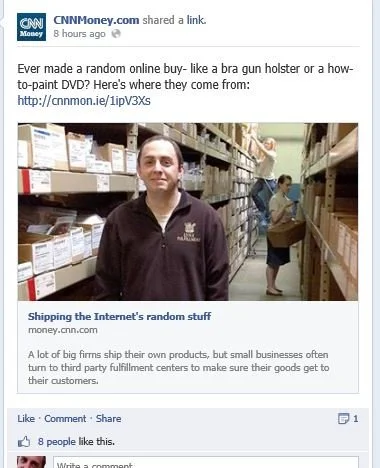
I still remember the moment my third-party fulfillment company received the call to appear on CNN Money.
The story was titled: “Shipping the Internet’s Random Stuff.” It was exciting -not because of the headline, but because of what it represented. That recognition wasn’t the result of a single big win or a lucky break. It came from long days, tight margins, scrappy problem-solving, and doing unglamorous work really well - over and over again.
Packing orders accurately. Meeting our SLA's. Fixing mistakes without excuses. Taking care of customers most people never see. And doing it so well that we were never seen - until that story.
Public recognition is often portrayed as sudden. In reality, it’s usually the byproduct of consistency when no one is watching.
That article may have been a moment of validation - but it was built on years of effort that never made a headline. Most meaningful recognition works that way. It shows up late. It shows up quietly. And it only finds teams that were already doing the work anyway.
The lesson stuck with me: focus on execution first. The spotlight, if it comes at all, follows the grind - not the other way around.
The gray area
Not every decision comes with a clear right or wrong answer.
Some of the hardest moments in leadership live in the gray - where data is incomplete, opinions differ, and waiting feels just as risky as acting. That’s ambiguity.
In those moments, progress doesn’t come from certainty. It comes from judgment. It comes from testing assumptions. You choose a direction knowing it may need to change. You commit anyway because indecision has a cost.
Strong leaders don’t pretend the answer is obvious. They’re transparent about trade-offs and clear about intent. When there’s no perfect choice, the goal isn’t perfection. It’s forward motion with accountability.
Ambiguity doesn’t disappear with more meetings or more slides. It gets resolved by thoughtful action, learning, and adjustment.
Leadership isn’t about always being right. It’s about moving forward when the answer isn’t clear and owning the outcome either way.
Co-manufacturing and relationships
Co-manufacturing in the meat industry isn’t just outsourcing production. It’s a math problem wrapped in a relationship.
You don’t send pallets of finished goods - you send raw material. What comes back is shaped by quality, trim, moisture loss, cook loss, handling, and yield discipline. That’s where many partnerships struggle.
If you’re not tightly aligned on expected yield by SKU, where loss is acceptable vs. preventable, and how variances are measured and reported
you’ll argue about inventory instead of improving performance.
In meat, yield is margin. A few points of unexplained loss can erase profitability faster than pricing ever will.
Strong co-manufacturing relationships treat yield as a shared responsibility, not a finger-pointing exercise. The best partners will define yield assumptions upfront, track raw-to-finished conversion transparently, and reconcile often.
The companies that win don’t ask, “Did we get the product back?” They ask, “Did we get the yield we planned for and do we both understand why or why not?” Because in meat co-manufacturing, trust is built in ounces, not in words.
Why do you do it?
I was asked - Why do you do it? Simple question with so many possible answers. But after reflecting - I have my answer.
I do it for the moments no one posts about.
I do it for the first day a team member realizes they’re not “just a a team member" - they’re leading a project, influencing decisions, and earning the respect of seasoned operators.
I do it for turning worn-out buildings into productive operations. For taking chaos, constraints, and half-working processes and turning them into something that actually hums.
I do it for the uncomfortable conversations. The stockout explanations. The margin pressure. The systems that should work but don’t - yet.
I do it because complex supply chains are puzzles worth solving. Because when communication is messy, data is incomplete, and the stakes are real, leadership actually matters.
I do it to build teams that don’t need heroics to win - just clarity, trust, and accountability.
I do it because there’s nothing more satisfying than watching people and processes level up at the same time.
That’s why I do it.
Customer Lifetime Value is an operational outcome
Customer Lifetime Value isn’t just a marketing metric. It’s an operational outcome.
Every late shipment, partial fill, damaged box, or “we’ll get back to you” moment quietly chips away at LTV. And every on-time delivery, accurate order, and effortless return does the opposite.
Supply chain is where promises either become habits or churn. Inventory accuracy determines whether customers trust “in stock.” Fulfillment speed determines whether they come back. Packaging, substitutions, and communication determine whether they recommend you or replace you.
You don’t build lifetime value with one great experience. You build it with consistent, boring operational excellence at scale.
Don’t ask, “What does this save us?” Ask, “What does this cost us over the customer’s lifetime?” Because in the end, LTV isn’t owned by Marketing or Sales. It’s protected or destroyed by Operations.
Weather is a risk event
For those of us in supply chain, weather isn’t just a forecast - it’s a risk event. It impacts drivers, warehouses, ports, plants, and the people holding all of it together.
A reminder as this weather event continues and conditions deteriorate:
No load is worth a life. No service level justifies unsafe roads. No recovery plan works if your people aren’t okay. Delays will happen. Networks will flex. That’s what resilient supply chains do.
Great operators plan for disruption. Great leaders protect their teams during it.
If you’re in the storm’s path - slow down, stay home if you can, and check on your people. Stay safe out there.
Pulse Check
Pulse Check.
How are you feeling heading into the weekend?
No fixing. No optimizing. Just a moment to be honest. Go ahead - be vulnerable!
I'll make a comment about how I'm feeling. I challenge you to do the same.
Sometimes the most productive thing we can do is acknowledge where we actually are before we reset and do it again on Monday.
Hope you find a little space to recharge.
The Intern
Every now and then, an intern shows you what potential really looks like.
One summer, I had an intern who set herself apart almost immediately. Not because she talked the most - but because she did the work.
She jumped into real projects without hesitation. She built data models that actually helped decisions get made. And she earned the respect of operations managers and frontline team members through competence.
That doesn’t happen by accident. She asked smart questions. She listened before offering solutions. She led from the front. And she treated the role like an opportunity, not a placeholder. Great interns don’t wait to be managed. They look for ways to add value.
She reminded me that talent shows up early - and when it does, it’s obvious.
If you’re wondering what separates a good intern from a great one - it's
curiosity, ownership, and the courage to step into real work. Every leader hopes to have that intern on their team.